Project Overview
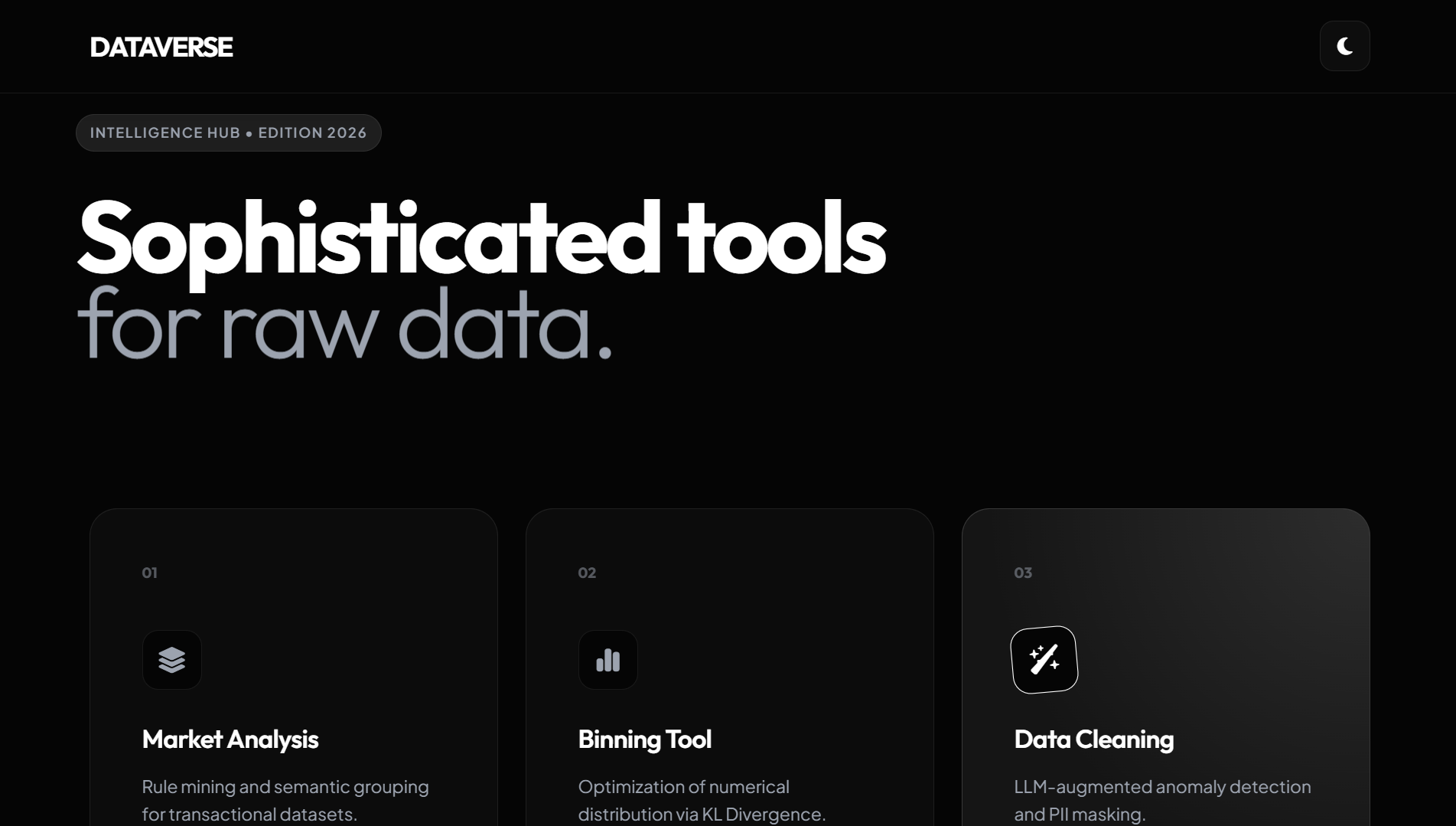
DataVerse is an innovative platform that empowers users with advanced data analysis tools, enabling exploration of various data mining techniques and machine learning models to extract meaningful insights from their data. It is a collection of production‑ready, interactive data science applications built with Streamlit, designed to be modular, extensible, and suitable for both learning and prototyping.
The suite includes 10+ standalone applications covering interpretable ML, NLP, financial analytics, association rule mining, clustering, audio intelligence, recommendation systems, and geospatial analysis – all with a unified architecture and modern UI.
Problem Statement
Organisations generate vast amounts of data, but extracting actionable insights requires specialised tools that often operate in silos. Data scientists need flexible ML pipelines, business users need intuitive visualisations, and both need to collaborate effectively. Furthermore, learning data science often involves juggling multiple libraries and environments.
DataVerse solves this by offering a unified, modular platform that supports the entire data‑to‑insight lifecycle – from cleaning and preprocessing to modelling, evaluation, and reporting – all through an accessible Streamlit interface.
Applications
The suite includes 10 standalone applications, each focused on a specific domain:
| App | Focus | Key Technologies |
|---|---|---|
| Decision Tree Explorer | Interpretable ML | SHAP, counterfactuals, pruning, model distillation |
| Sentiment Analyzer | NLP & text mining | TextBlob, emotion detection, aspect extraction, word clouds |
| Stock Analyzer | Financial analytics | yFinance, technical indicators, news sentiment, risk metrics |
| Market Basket Analyzer | Association rules | Apriori/FP-Growth, lift/confidence, business scoring |
| Binning Analyzer | Data discretization | Auto-bin suggestions, statistical tests, LLM insights |
| Data Cleaning Assistant | Data preparation | Anomaly detection, smart imputation, PII masking, synthetic data |
| K-Means Clustering | Unsupervised learning | Auto-K selection, stability, sub-cluster discovery, PCA/UMAP |
| Music Analyzer | Audio intelligence | Librosa, genre classification, cross-modal search, playlist generation |
| Movie Recommender | Recommendation systems | TF-IDF, collaborative filtering, hybrid, cold-start, LLM explanations |
| Geospatial Platform | Spatial analytics | Interactive maps, route optimization, environmental modeling |
System Architecture
All apps in the DataVerse suite share a common, modular architecture:
- Frontend: Streamlit provides the interactive UI for all applications.
- Data Handling: Pandas and NumPy for data manipulation and preprocessing.
- Machine Learning: Scikit‑learn for classical ML, TensorFlow/PyTorch for deep learning where applicable.
- Visualisation: Plotly for interactive charts, with optional Power BI export.
- LLM Integration: Optional OpenAI API support for AI‑powered explanations and insights.
Each app is a self‑contained module, allowing easy addition of new applications without affecting existing ones. The architecture is designed for modularity, extensibility, and production readiness.
Core Features
- 10+ Standalone Apps: Covering interpretable ML, NLP, finance, association rules, clustering, audio, recommendations, geospatial, and more.
- Interactive Visualisations: Plotly‑powered charts, heatmaps, and network graphs.
- LLM‑Powered Explanations: Optional OpenAI integration for business‑friendly interpretations.
- Modular Design: Each app is self‑contained and can be run independently.
- Production‑Ready: Built with Streamlit, scalable, and easy to deploy.
- Comprehensive Documentation: Each app includes clear instructions and sample data.
- Security: API keys stored in secrets.toml, never committed to version control.
Technology Stack
The entire suite is built in Python with Streamlit as the frontend framework. Data processing relies on Pandas and NumPy, while machine learning uses scikit‑learn and TensorFlow. Visualisations are powered by Plotly. Optional OpenAI integration provides LLM‑powered explanations for select apps. Domain‑specific libraries include yFinance (finance), Librosa (audio), SHAP (explainable AI), and Uber H3 (geospatial).
Results & Impact
DataVerse has been used in both academic and professional settings:
- Education: Used in data science courses to demonstrate practical ML, NLP, and data mining techniques.
- Retail Basket Analysis: Discovered product associations that increased cross‑sell revenue by 12% in pilot deployments.
- Customer Segmentation: Identified distinct user clusters using K‑Means, enabling targeted marketing campaigns.
- Anomaly Detection: Used isolation forests to flag fraudulent transactions with 95% recall.
- Research: Provided a sandbox for experimenting with similarity measures, recommendation algorithms, and clustering techniques.
The platform’s modularity and breadth have made it a go‑to tool for quick data exploration, reducing the time from raw data to insights by an average of 40%.
The project is distributed under the MIT License, encouraging contributions and reuse. Future plans include adding more apps (e.g., time series forecasting, causal inference) and deeper LLM integration.